This blog is a networking resource for ASDIN members. It is not intended to be utilized as legal or medical advice. ASDIN offers this blog as is, without any express or implied warranties, or other assurances as to the content of the material contained herein. ASDIN assumes no responsibility for errors or omissions contained herein, or for any actions taken or damages suffered by any person on the basis of, or in reliance upon, any of the information contained herein. Cases and images should ALWAYS be stripped of any/all patient-specific information (name, DOB, MR#, etc.). Cases should be well thought out and suitable for distribution.
Language usage should be polite, collegial, and professional. If it is found that a participant is not using appropriate language, that participant’s comment may be blocked.
Top tags:
tunneled dialysis catheter
Policy and Procedure
articles of interest
AVF
central vein stenosis
Coding
billing
Central Stents
policies
svc thrombus
accessory veins
accessory veins/ Coils
articles of interest; RESCUE
ASC
ash
AVF endovascular at SSM STL
AVF Maturation
CABG
case
Catheter Exchange
Catheter Selection; catheter; tunneled dialysis ca
Clot at tip of hemodialysis catheter
clotted forearm graft
codes
Consents
consult
Conversion
COVID-19
Declot
dialysis staff
  
|
Posted By Administration,
Tuesday, June 2, 2020
|
The American Society of Diagnostic and Interventional Nephrology (ASDIN) strongly opposes acts of discrimination and racism and grieves with our African-American patients and colleagues, our communities, and our nation. The tragic death of George Floyd is a stark reminder of the constant ongoing struggles of inequality and injustice. As healthcare professionals dealing with a global pandemic that has affected minority communities disproportionately, our members have also seen firsthand the havoc created by the disease and existing health disparities. Now more than ever, it is imperative that we all come together to fight against racism, discrimination, crippling health disparities and commit to ensuring equity for all.
In furtherance of our mission, ASDIN values diversity, inclusion, tolerance, respect for others, and, above all, the value of human life. The American Society of Diagnostic and Interventional Nephrology vows to continue to raise a collective voice against injustice.
Statement by Executive Committee - Anil Agarwal, MD; Vandana Dua Niyyar, MD; Bharat Sachdeva, MD and Monnie Wasse, MD - on behalf of ASDIN
This post has not been tagged.
Permalink
| Comments (0)
|
|
|
Posted By Administration,
Thursday, May 14, 2020
|
|

In an effort to support patients who may be indirectly affected by COVID-19, Medtronic recently announced a donation program for the IN.PACT™ AV Drug Coated Balloon for Arteriovenous Access Maintenance in patients with end stage renal disease (ESRD). ESRD patients undergoing regular hemodialysis, which has been deemed an essential procedure during the pandemic, are at high risk for exposure to and complications from COVID-19.
In the IN.PACT AV Access Trial, IN.PACT AV demonstrated a 56% reduction in fistula reinterventions vs. PTA at six months1, offering a unique clinical benefit. Medtronic hopes this donation program will help extend the time to reintervention, thereby limiting the time ESRD patients are in the hospital.
U.S. sites affected by COVID-19 and performing AV access maintenance procedures may submit IN.PACT AV product donation requests via theMedtronic Giving Connection. Medtronic will donate up to $10 million in product, with each request fulfilled using a standardized 10-unit kit.
1.Results from the IN.PACT™ AV Access Clinical Trial found in the IN.PACT™ AV drug-coated balloon (DCB) Instructions For Use (IFU).
More Information:https://www.asdin.org/resource/resmgr/covid_19/INPACT_AV_Donation_Applicati.pdf
|
This post has not been tagged.
Permalink
| Comments (0)
|
|
|
Posted By Abigail Falk,
Wednesday, April 29, 2020
|
This post has not been tagged.
Permalink
| Comments (0)
|
|
|
Posted By Abigail Falk,
Friday, April 3, 2020
|
This post has not been tagged.
Permalink
| Comments (0)
|
|
|
Posted By Dirk M. Hentschel,
Wednesday, March 18, 2020
|
Credit to Keith Ozaki who is co-originator of this information
Apropos discussion of elective vs urgent/emergent cases. – Our program does on average 9-10 cases per day, 1-2 thrombectomies, 2-4 fistulograms with angioplasty that were on the verge of thrombosis, 1-2 tunneled catheter procedures, and the rest more or less elective stuff (not so urgent fistulogram stenoses, central vein recanalization, hand pain [depending on degree of pain may be urgent], etc.).
Our concern has been that we cannot distinguish without patient contact which of the fistulogram referrals are urgent/emergent versus relatively elective. We find that if a dialysis unit thinks there is a problem there usually is a very advanced problem and we know that we cannot deal with 5-6 thrombectomies every day.
For this reason we have made almost all referral indications “high priority” (see pasted below), similary for OR procedures. – We also have access to two procedure rooms and designated one of the rooms a Covid-19-+ve space to brings patients directly into the room, improve staff/provider adherence with PPE policies, and facilitate room cleaning/air exchange [the latter is an overkill policy by hospital that will likely fall by the wayside, it holds true for TB/airborne, but should not apply to Corono/droplet]. – Lastly, all consents are done verbally.
The experience in Asian and Europe suggest a 40-50 days curve without flattening and something (much) longer with flattening. So our question is “Can this access problem wait for 3 months or not?”. Most interventions buy at least 3 months time, so anything we can do now prevents an emergency procedure during a period when everybody is sick, staff is out, providers are cross-covering.
Baseline assumptions:
- There will be more Covid19 exposed / infected (:= Covid19+) dialysis patients than hospitals can manage to dialyze as inpatients (so admitting all of these patients is unlikely to be a solution)
- Consequently, some Covid19+ dialysis patients will dialyze in the community, possibly dedicated HD units, and will look for dialysis access care in the usual way
- There will be a subset of Covid19+ dialysis patients who will require dialysis at hospital after an emergency access procedure due to volume/hyperkalemia/scheduling issues, 20-33% of thrombectomy patients seems a reasonable estimate
- We will not decline care for Covid19+ patients
- Care may return to “normal” in 3 months (40-50 days for rise and fall of cases with a tail)
Process of care questions:
- Is there a way to create/dedicate “isolated” pre-post-evaluation/monitoring space?
- What are room cleaning and air exchange requirements after a Covid19+ case?
- Can procedural space be dedicated to Covid19+ patients?
- Timing of Covid19+ cases during the day to allow for cleaning procedure if dedicated space limited?
- Where will Covid19+ outpatients receive emergency post-procedure dialysis ?
- How is EMS and The Ride handling Covid19+ patients?
- Will the waiting room be able to accommodate Covid19+ patients in a safe way? If not, what space is available for Covid19+ patients to wait?
Triage Process for Dialysis Access procedures - Endovascular
High Priority (access := fistula/graft/PD catheter/tunneled hemodialysis catheter that are used for dialysis):
- Outpatient thrombectomies without other access
- Outpatient bleeding access
- Outpatient access with clinical/laboratory signs of extreme dysfunction or inability to use
- Outpatient access with signs and symptoms of cardiac strain, limb ischemia and impending tissue loss (high flow)
- New initiations with volume or electrolyte emergencies/urgencies
- AKI in ICU/floor with need for dialysis
- Outpatient access with new onset arm edema jeopardizing use of access or incapacitating limb use/movement
- Inpatients thrombectomies
- Inpatients access dysfunction (may not be as extreme as above) if this keeps patient in hospital
- Outpatient access, not in use, with impending signs of occlusion
- Catheter removals (as long as staff and resources available, to prevent infections during time when staff and resources are overwhelmed)
- Venograms for access creation on specific urging of nephrologist when surgery is also pressing ahead (See Open Surgery HD Access Cases Performance Plan)
Low Priority:
- Venograms for access placement (occasionally they may be necessary to guide urgent/emergent revision of a dysfunction/non-functional access)
- Scheduled follow-up exams – institute enhanced screening by phone asking specific data on access function: trend of access flow past 4-6 months, trend of clearance 4-6 months, change in bleeding after needle removal, obtain photo of access
Open HD Access Cases Performance Plan
Joint HD access clinics will continue with individual visit review the week prior for appropriateness and opportunity for delay/virtual or phone visit
Delay these types of cases:
- New HD access placement in stable, minimally to asymptomatic patients with eGFR of >15
- Permanent HD access placement in patient with functioning catheters and no known issues with catheter infections, thrombotic complications
- Asymptomatic non-used fistula ligation
- Asymptomatic AV access aneurysms without threatening signs (large thrombus, thin skin, etc.)
- Difficult augmentation/cannulation in patient without ESRD
Continue with example cases below:
- Thrombosed/failing access unable to be managed by endovascular approach
- Steal syndrome
- High flow access with complications such as Bleeding, CHF, Steal
- Infection
- Difficult augmentation/cannulation in patient with catheter in place
- Failure to mature with impending access loss
- Procedures requested for expedited care by referring nephrologist
- Inpatients in which access procedure will expedite patient progression
- Tunneled hemodialysis catheter placement or exchange that otherwise cannot be accommodated
To be reviewed real time for iterative as needed modifications
Tags:
COVID-19
Permalink
| Comments (6)
|
|
|
Posted By Marc Webb,
Wednesday, January 29, 2020
|
As I mentioned in a previous post, I became enthused about early cannulation grafts because they let me revise or replace a failing access without needing an interval catheter. Then I started using them primarily, first Flixene, then Acuseal when Flixene went into a prolonged backorder situation. Over a ten year period, I put in several hundred of each. Recently, I became concerned about an abnormal rate of repeat thrombosis in relatively new Acuseal grafts. I no longer use them.
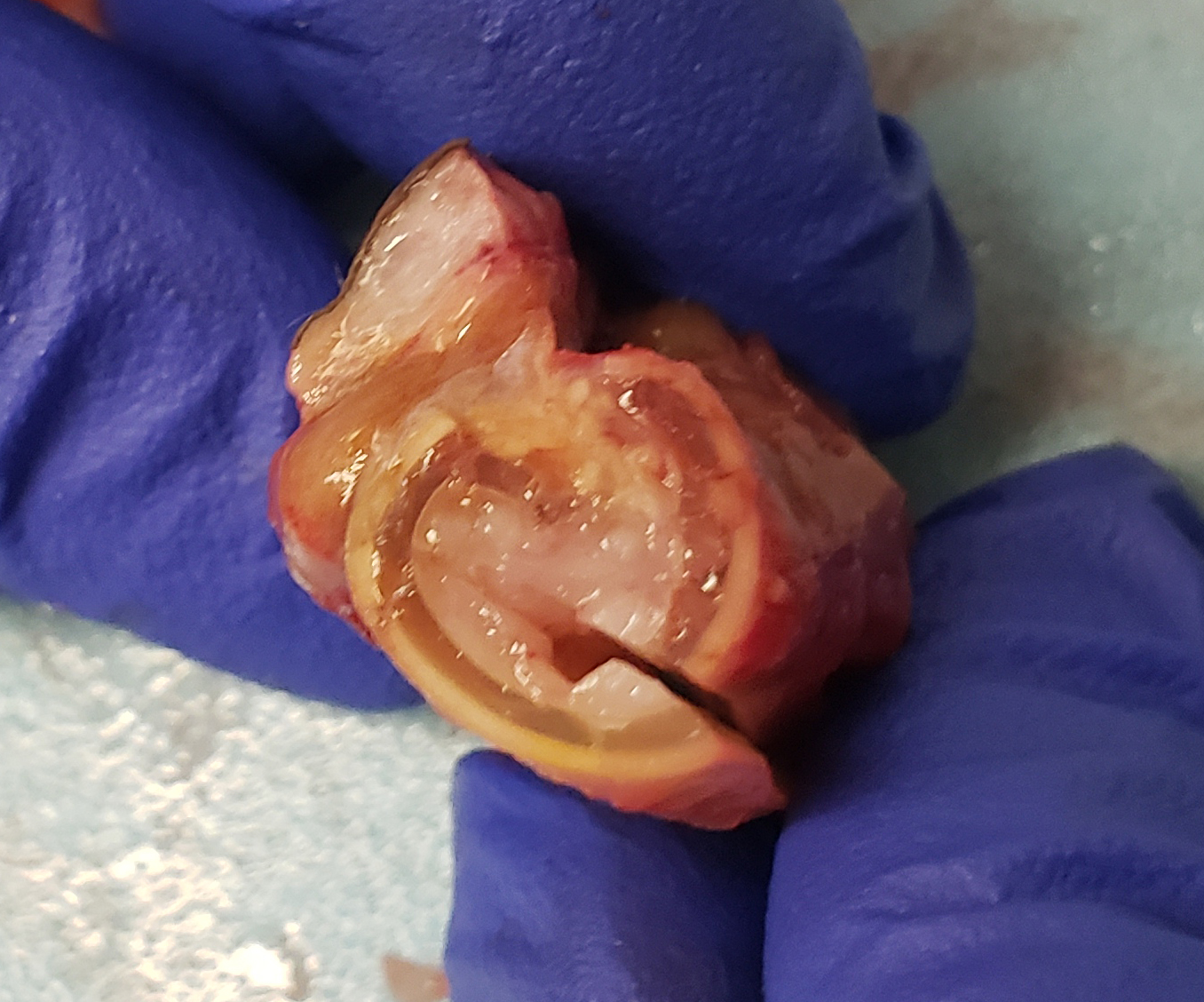
Here, I have images of a graft placed in April 2018, and replaced with a Flixene graft (no catheter) this month, lasting less than 2 years. Ironically, her first graft was a Flixene, placed in 2012, and replaced in 2018 with the Acuseal. I took segments out during this last transition because I wanted to know why the Acuseal did not last as long as the Flixene. In one image, fibrosis in the zone of frequent cannulation pushes a partly disrupted silicone layer further into the lumen. In the other, the graft wall is fairly well preserved, but the lumen is full of an amorphous hyaline material, also present in the other image. I don't see many sectioned dialysis grafts, but I have never seen this kind of hyaline material in a newer graft, and especially not where the graft has not experienced heavy use. Remember that these graft segments were running and not thrombosed when they were excised and replaced. Any ideas? I will be reviewing this with a pathologist this week, and may have better images then. The specimens have been preserved if there is an interest.
I will be doing a retrospective review of the Acuseal versus the Flixene, perhaps with a standard PTFE, and a BVT group as well.

Attached Thumbnails:
This post has not been tagged.
Permalink
| Comments (0)
|
|
|
Posted By Marc Webb,
Wednesday, January 29, 2020
|
As I mentioned in a previous post, I became enthused about early cannulation grafts because they let me revise or replace a failing access without needing an interval catheter. Then I started using them primarily, first Flixene, then Acuseal when Flixene went into a prolonged backorder situation. Over a ten year period, I put in several hundred of each. Recently, I became concerned about an abnormal rate of repeat thrombosis in relatively new Acuseal grafts. I no longer use them.
Here, I have images of a graft placed in April 2018, and replaced with a Flixene graft (no catheter) this month, lasting less than 2 years. Ironically, her first graft was a Flixene, placed in 2012, and replaced in 2018 with the Acuseal. I took segments out during this last transition because I wanted to know why the Acuseal did not last as long as the Flixene. In one image, fibrosis in the zone of frequent cannulation pushes a partly disrupted silicone layer further into the lumen. In the other, the graft wall is fairly well preserved, but the lumen is full of an amorphous hyaline material, also present in the other image. I don't see many sectioned dialysis grafts, but I have never seen this kind of hyaline material in a newer graft, and especially not where the graft has not experienced heavy use. Remember that these graft segments were running and not thrombosed when they were excised and replaced. Any ideas? I will be reviewing this with a pathologist this week, and may have better images then. The specimens have been preserved if there is an interest.
I will be doing a retrospective review of the Acuseal versus the Flixene, perhaps with a standard PTFE, and a BVT group as well.

Attached Thumbnails:
This post has not been tagged.
Permalink
| Comments (0)
|
|
|
Posted By Marc Webb,
Wednesday, January 29, 2020
|
As I mentioned in a previous post, I became enthused about early cannulation grafts because they let me revise or replace a failing access without needing an interval catheter. Then I started using them primarily, first Flixene, then Acuseal when Flixene went into a prolonged backorder situation. Over a ten year period, I put in several hundred of each. Recently, I became concerned about an abnormal rate of repeat thrombosis in relatively new Acuseal grafts. I no longer use them.
Here, I have images of a graft placed in April 2018, and replaced with a Flixene graft (no catheter) this month, lasting less than 2 years. Ironically, her first graft was a Flixene, placed in 2012, and replaced in 2018 with the Acuseal. I took segments out during this last transition because I wanted to know why the Acuseal did not last as long as the Flixene. In one image, fibrosis in the zone of frequent cannulation pushes a partly disrupted silicone layer further into the lumen. In the other, the graft wall is fairly well preserved, but the lumen is full of an amorphous hyaline material, also present in the other image. I don't see many sectioned dialysis grafts, but I have never seen this kind of hyaline material in a newer graft, and especially not where the graft has not experienced heavy use. Remember that these graft segments were running and not thrombosed when they were excised and replaced. Any ideas? I will be reviewing this with a pathologist this week, and may have better images then. The specimens have been preserved if there is an interest.
I will be doing a retrospective review of the Acuseal versus the Flixene, perhaps with a standard PTFE, and a BVT group as well.

Attached Thumbnails:
This post has not been tagged.
Permalink
| Comments (0)
|
|
|
Posted By Abigail Falk,
Thursday, January 23, 2020
|
This post has not been tagged.
Permalink
| Comments (0)
|
|
|
Posted By Abigail Falk,
Monday, January 6, 2020
|
This post has not been tagged.
Permalink
| Comments (0)
|
|
|
Posted By Abigail Falk,
Thursday, December 19, 2019
|
This post has not been tagged.
Permalink
| Comments (0)
|
|
|
Posted By Marc Webb,
Monday, December 16, 2019
|
I am looking for recommendations on statistics software to be used in my office practice to translate cases into "data" - Kaplan-Meier graphs, and so on. I have no real institutional alliance at present, and am looking for something that would help me follow and analyze 300 central venous stents, for example. I am sure there is expertise out there to help me avoid a costly mistake and wasting time with the wrong product. Any reflections or advice would be much appreciated.
This post has not been tagged.
Permalink
| Comments (2)
|
|
|
Posted By Marc Webb,
Saturday, December 14, 2019
|
Brief background: I have been a full-time vascular access surgeon for 20 years, placing grafts, creating fistulas, and performing endovascular maintenance and rescue, including declots. I am a big fan of early cannulation grafts, and have used them frequently since 2011, first Flixene, then after 2015, Acuseal, without major problems. However, in July of 2019 I noticed an unexplained rise in thrombotic events in patients with relatively newly placed grafts, along with some imaging suggesting delamination of the inner PTFE layer of the Acuseal graft. The middle layer of silicone is both ultrasound and radiolucent, and the inner layer of PTFE is quite thin, so imaging is difficult. The only remedy I have found is a covered stent in the zones of cannulation (Fluency). I have stopped using this graft.
Has anyone else had these problems with Acuseal grafts? Are there any insights to share?
This post has not been tagged.
Permalink
| Comments (12)
|
|
|
Posted By Nephrology Associates PA Vascular Access Center,
Tuesday, September 10, 2019
|
We received this email from our Billing Coordinator today:
"We are still not getting paid when we bill the 36595 with modifier 52. I called Medicare again today to clarify and the code is being bundled with the 36581. The only way to un-bundle this would be with a modifier. I am not sure if there is an appropriate modifier to use in these cases as the 36595 is being done at the same site as the 36581. Any guidance you could give me on this would be appreciated. Thank you!"
I offered to share it here to see if anyone has had any luck getting this code paid, what modifiers they are using, etc. We do use the coding manual tip of adding an additional statement to our procedure note.
Any info would be appreciated, thanks!
Tags:
billing
codes
reimbursements
Permalink
| Comments (0)
|
|
|
Posted By Abigail Falk,
Monday, August 5, 2019
|
|
Permalink
| Comments (0)
|
|
 Blog Home
 All Blogs

 Print Page
 RSS
RSS